
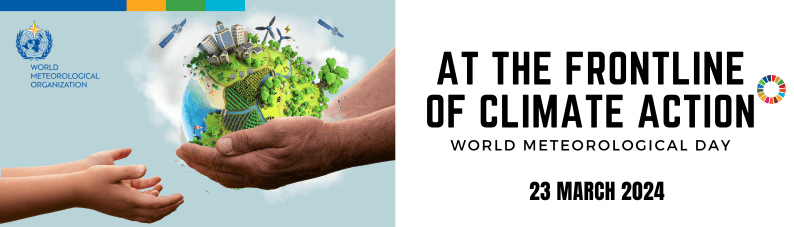
March 23, the World Meteorological Organization commemorates the coming into force of the Convention establishing the World Meteorological Organization on 23 March 1950.

It showcases the essential contribution of the National Meteorological and Hydrological Services to the safety and well-being of society and is celebrated with activities around the world. The themes chosen for World Meteorological Day reflect topical weather, climate or water-related issues.
The theme for World Meteorological Day 2024 is “At the frontline of climate action”.
WHAT IS Meteorology
Meteorology is the scientific study of the atmosphere and its phenomena, with a primary focus on weather forecasting. So basically Meteorology encompasses the systematic study of weather and its causes. It provides the foundation for predicting weather conditions.
- The term “meteorology” is derived from the Ancient Greek words: μετέωρος (metéōros), meaning “high in the air,” and -λογία (-logia), which signifies “the study of.”
- It deals with atmospheric events, including temperature, air pressure, water vapour, and their interactions over time.
History of Meteorology
The development of meteorology is deeply connected to developments in science, math, and technology. The Greek philosopher Aristotle wrote the first major study of the atmosphere around 340 B.C.E. However nany of Aristotle’s ideas were incorrect because he did not believe it was necessary to make scientific observations.
A growing belief in the scientific method profoundly changed the study of meteorology in the 17th and 18th centuries. Evangelista Torricelli, an Italian physicist, observed that changes in air pressure were connected to changes in weather. In 1643, Torricelli invented the barometer, to accurately measure the pressure of air. The barometer is still a key instrument in understanding and forecasting weather systems.
In 1714, Daniel Fahrenheit, a German physicist, developed the mercury thermometer. These instruments made it possible to accurately measure two important atmospheric variables.
There was no way to quickly transfer weather data until the invention of the telegraph by American inventor Samuel Morse in the mid-1800s. Using this new technology, meteorological offices were able to share information and produce the first modern weather maps. These maps combined and displayed more complex sets of information such as isobars (lines of equal air pressure) and isotherms (lines of equal temperature). With these large-scale weather maps, meteorologists could examine a broader geographic picture of weather and make more accurate forecasts.
In the 1920s, a group of Norwegian meteorologists developed the concepts of air masses and fronts that are the building blocks of modern weather forecasting. Using basic laws of physics, these meteorologists discovered that huge cold and warm air masses move and meet in patterns that are the root of many weather systems.
Military operations during World War I and World War II brought great advances to meteorology. The success of these operations was highly dependent on weather over vast regions of the globe. The military invested heavily in training, research, and new technologies to improve their understanding of weather. The most important of these new technologies was radar, which was developed to detect the presence, direction, and speed of aircraft and ships. Since the end of World War II, radar has been used and improved to detect the presence, direction, and speed of precipitation and wind patterns.
The technological developments of the 1950s and 1960s made it easier and faster for meteorologists to observe and predict weather systems on a massive scale. During the 1950s, computers created the first models of atmospheric conditions by running hundreds of data points through complex equations. These models were able to predict large-scale weather, such as the series of high- and low-pressure systems that circle our planet.
TIROS I, the first meteorological satellite, provided the first accurate weather forecast from space in 1962. The success of TIROS I prompted the creation of more sophisticated satellites. Their ability to collect and transmit data with extreme accuracy and speed has made them indispensable to meteorologists. Advanced satellites and the computers that process their data are the primary tools used in meteorology today.
So one can say clearly that ……….. Slowly and gradually this field expanded due to various newly developed technologies. Today’s meteorologists have many tools that help them examine, describe, model, and predict weather systems. These technologies are applied at different meteorological scales, improving forecast accuracy and efficiency.
some of its examples include – RADAR, dual-polarization radar, Tornado, Satellites, GOES-15, launched in 2010,
WHY THIS DAY IS CELEBRATED?
The World Meteorological Organization (WMO) was established in March 1950, becoming a specialized agency of the United Nations in 1951. This marked a significant shift towards international cooperation in meteorology, hydrology, and related sciences. Discussions for its establishment began in the mid-1930s due to the increasing importance of meteorology. Despite initial progress, World War II delayed formal approval. Post-war efforts intensified, leading to the WMO’s formation. The organization’s focus includes standardization, research, education, and addressing meteorological challenges on a global scale.
In 1950, on March 23, the World Meteorological Organisation was founded to predict weather and climate changes. World Meteorological Day was announced by the World Meteorological Organisation, a year after being founded. They wanted to celebrate their foundation day and also spread awareness about the importance of predicting weather and climate changes.
Significance
World Meteorological Day stands as a pivotal occasion emphasizing global recognition of various challenges facing our planet. This day serves to raise awareness worldwide about pressing issues affecting Earth and underscores the crucial role of individuals and their actions in safeguarding the atmosphere.
The day aims to create awareness about the significance of predicting weather changes and climate change mitigation. The World Meteorological Organisation aims to help people lead a healthier and prosperous life by predicting weather changes. The rapid climate change and global warming in the world demand quick action. The best way to celebrate the special day is by creating awareness and raising our voices to take the precautions necessary to reverse climate change. Pressing climate challenges, natural disasters and the need to protect the planet are addressed on this day. We can celebrate the special day by learning more about weather changes, helping with relief funds and educating ourselves about how nature, weather and climate work.

BIBLIOGRAPHY
https://wmo.int/world-meteorological-day
 LIVE BY CHOICE NOT BY CHANCE!!!!
Leave a comment