
Life without water ……….is like life without oxygen .
Water is an essential element to life .It is used for various purpose and is consumed by every living creature .Chemically, water is a compound formed by the combination of two molecules of hydrogen and one molecule of oxygen. This reaction is highly exothermic although it requires heat for initiation.
So the formation of water is a highly exothermic process. So, the formation of such a tremendous amount of water could have released a lot amount of heat. However, some water may have such origin.
Due to various reasons water is getting polluted day by day which in tern affecting human health ,terrestrial and ariel habitants along with organisms living under water . Many water borne diseases are also caused by it which is becoming injurious to life.
Some reasons could be like —————-
Causes of Water Pollution – Anthropological and Natural
Water is able to dissolve many substances, hence it is called the universal solvent. This is the same reason why water pollution occurs easily. Following are the causes of water pollution:
Sewage and wastewater:
Many households dump their waste directly into water bodies. Moreover, households which are not served by municipal treatment plant may use septic tanks, which eventually infiltrates into the soil, causing pollution of groundwater.
Industrial effluents and Industrial Usage:
Some industries may directly pump their untreated wastes into water bodies such as rivers. Moreover, various industries also use water as a coolant, thereby causing thermal pollution. Increased water temperatures can cause a reduction in the levels of oxygen; which can cause the death of fish and other organisms.
Eutrophication
Eutrophication is caused when large quantities of nutrients are introduced into a body of water, causing the rapid growth of algae. This can decrease the oxygen level in the water, rendering the fish unable to breathe. Moreover, this phenomenon can also introduce dangerous toxins into the water body, which can harm or kill most organisms, including humans
Deforestation
Deforestation can cause soil erosion. When these loose soil particles enter a water body, they can make the water murky. This can make the water very murky, and it also has the potential to cause mechanical damage to aquatic organisms, (such as sand particles getting stuck in gills).
Agricultural run-offs
Agricultural run-offs include fertilizers and other chemicals that can make the water toxic. Moreover, some of these fertilizers can induce eutrophication.
Accidents
Accidents can involve events such as leaks and oil spills. Oil spills, in particular, are very damaging to the environment and aquatic life. It occurs when large oil tankers, barges or drilling rigs are involved in accidents. The most well-known oil spill was that of the Deep Water Horizon, which occurred on 20th April 2010.
As water is an essential element of human living. It is very useful only when it is unpolluted. It is in short supply since 97% of world’s water constitutes seawater, which is unfit for consumption. Polluted or contaminated water is injurious to health.
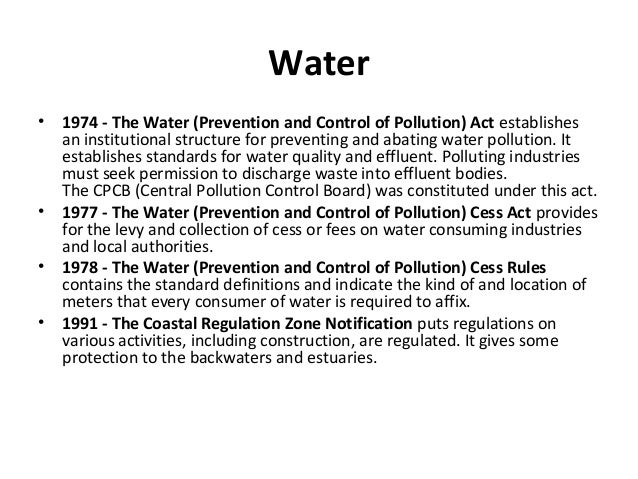
In order to prevent and control the pollution of water, the Indian Parliament passed the Water Act, 1974. The main purpose of the Water Act, as enshrined in its preamble is:
1.To prevent and control the pollution of water;
2. To maintain and restore the wholesomeness of water;
3. The establishment of Boards for prevention and control of water pollution; and
4. To confer on such Boards, powers to prevent and control water pollution and to maintain or restore the wholesomeness of water.
As the above objects pertain to State List, the Parliament has no power to legislate in this regard except under Arts. 249, 250 and 252. However, the States of Assam, Bihar, Gujarat, Haryana, Himachal Pradesh, Jammu and Kashmir, Karnataka, Kerala, Madhya Pradesh, Rajasthan, Tripura and West Bengal passed a resolution under Art. 252(1), requesting the Parliament to enact a law for prevention and control of water pollution. Consequently, the Parliament passed the Water Act in 1974 in INDIA.
Some Key Points of Water Act 1974 of India are ———
1. Water Act 1974 aims to prevent and control water pollution.
2. Under Water Act, 1974, pollution control boards were created, who are responsible for implementation of its provisions.
3. One of the important provision of the Water Act, 1974 is to maintain and restore the ‘wholesomeness’ of our aquatic resources.
4. Under Water Act 1974, Sewage or pollutants cannot be discharged into water bodies including lakes and it is the duty of the state pollution control board to intervene and stop such activity.
5. Anyone failing to abide by the laws of under is liable for imprisonment under Section 24 & Section 43 ranging from not less than one year and six months to six years along with monetary fines.
In order to stop the disastrous effects polluted water has on the ecosystem and human health, it is essential that each of us take simple, proactive steps to limit our contribution to this contamination.
Some of the ways we can reduce water pollution include:
- Reducing our usage of plastic consumption. Plastic water bottles are one of the biggest offenders and contributors to water pollution. Try to minimize your usage by buying glass or aluminum water bottles instead. Both of these are reusable and aluminum, in particular, decomposes fairly quickly, unlike plastic bottles which can take hundreds of years to decompose.
- Properly disposing chemicals, oils, and non-biodegradable items. Never drain these items down a drain, sink, or toilet as they end up surfacing back up in freshwater.
- Minimizing or avoiding usage of pesticides and herbicides on your lawn. Trying to reduce the usage of these chemicals can greatly reduce the amount of contaminants that end up in freshwater reservoirs.
- Maintaining your car so that no leaks from oil, antifreeze, or coolant seep into the environment.
- Picking up your trash. While it may be obvious that picking up your trash is good for the environment.
- Conserving the water in your household. By turning off the tap water when you are not using it, you are reducing the need for unnecessary water to have to go through a treatment cycle. The less contaminated water that needs treatment, the better the treatment will be for the water that is being cycled through for decontamination.
Well this is not all measures but if take little little steps regarding this .we can change a lot . As every single effort helps to grow community healthy ,fit and fine .

SO LET’S EACH ONE COME TOGETHER FOR THE PROTECTION OR OUR ENVIRONMENT IN WHAT EVER WAYS WE CAN .
@MANISHANANDAN
 LIVE BY CHOICE NOT BY CHANCE!!!!
Leave a reply to nandasagec Cancel reply